
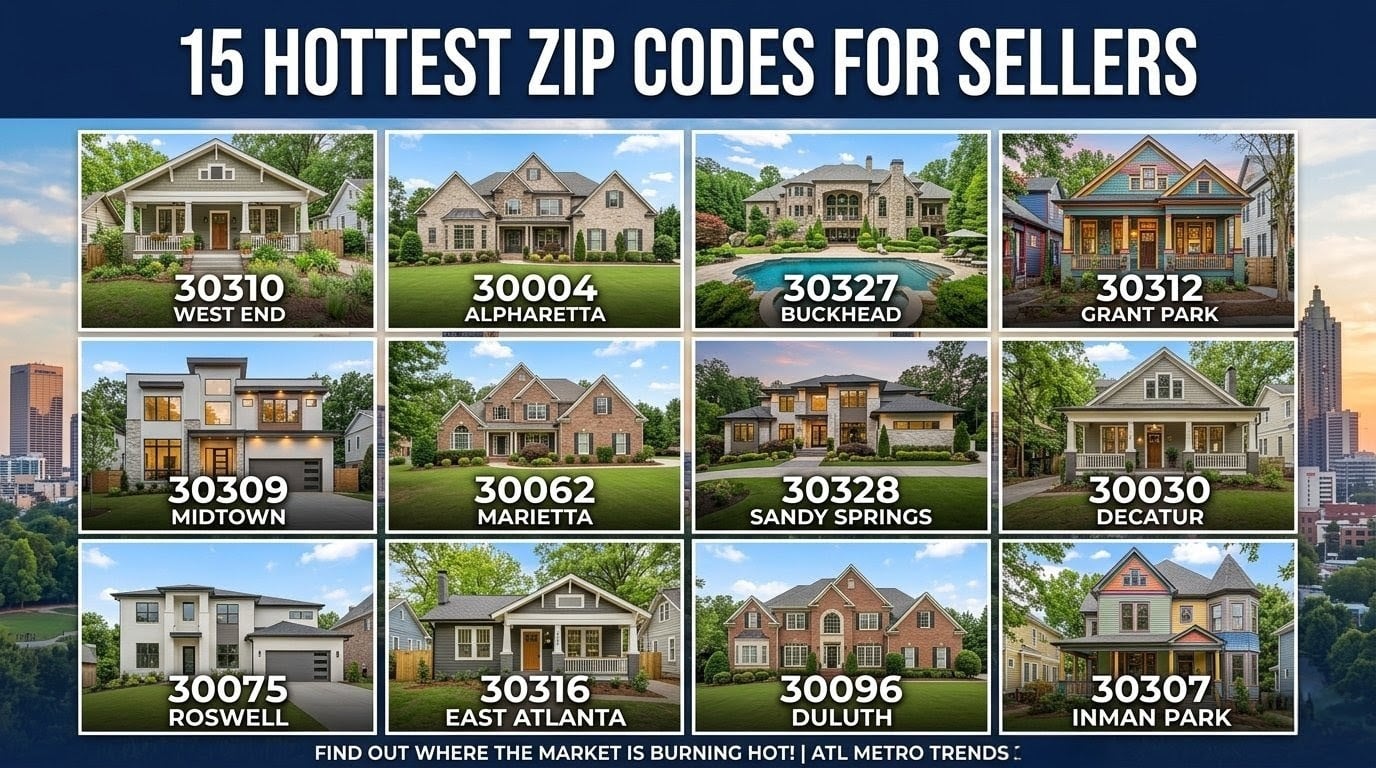
Not all Metro Atlanta markets are performing the same right now, and some zip codes are giving sellers a much stronger advantage than others. While you might hear broad headlines about Atlanta's real estate market, the truth is that your specific neighborhood could be experiencing completely different buyer demand, pricing power, and sale speeds than areas just a few miles away. This article will help you quickly spot whether your area is seeing stronger buyer demand, faster sales, and better pricing power so you can make a more confident decision about selling your home. You'll discover practical answers to the questions that matter most to you as a seller - whether now is a good time to list, how much leverage you may have in negotiations, and why local demand in your zip code matters more than general market reports. We'll first reveal the 15 hottest zip codes where sellers are achieving their goals with multiple offers and quick closings, then explain what specific factors are driving this demand in these areas - things like school ratings, job access, inventory shortages, and popular price points. Finally, you'll learn how to act on this insight with smart pricing and timing strategies that help you avoid leaving money on the table. Your home's location could be your biggest asset in this market, but only if you know how to use that advantage. Ready to find out if your zip code made the list and what that means for your selling strategy?
The 15 zip codes buyers are chasing right now
Sellers in these specific Metro Atlanta zip codes are experiencing the strongest buyer competition and fastest sale activity. Here's where buyers are concentrating their searches and making competitive offers right now.
- 30290 draws buyers with exceptional value compared to other south metro options, plus property tax rates that make homeownership more affordable for families seeking suburban space without premium pricing.
- 30005 attracts families relocating for top-rated educational opportunities, with Johns Creek's proximity to major employment centers creating consistent demand from professionals in tech and healthcare industries.
- 30116 appeals to buyers wanting larger homes and yards at price points that remain within reach, offering suburban living without requiring long commutes to Atlanta's business districts.
- 30068 continues pulling move-up buyers who prioritize established East Cobb neighborhoods, where mature trees and well-maintained communities combine with excellent school ratings.
- 30277 captures families drawn to Peachtree City's planned community lifestyle, where golf cart paths and recreational amenities create unique suburban charm that buyers actively seek.
- 30062 maintains steady buyer interest thanks to East Cobb's reputation for strong resale values, making it attractive to families who view their purchase as both a home and investment.
- 30004 benefits from Alpharetta's job growth in technology and healthcare sectors, with corporate relocations driving consistent buyer traffic from out-of-state professionals.
- 30064 offers West Cobb buyers homes with renovation potential at middle-market price points, appealing to those who want to customize properties while building equity.
- 30041 draws families to the Cumming and Forsyth County corridor, where lake access and outdoor recreation combine with highly rated schools to create lasting buyer interest.
- 30152 attracts steady relocation traffic to Lost Mountain's family-oriented neighborhoods, where buyers find confidence in the area's long-term growth and community stability.
- 30127 provides West Cobb affordability with homes that offer more square footage per dollar, plus renovation opportunities that appeal to buyers willing to invest sweat equity.
- 30310 sees growing interest from both investors and owner-occupants who recognize the area's affordability advantage compared to nearby intown neighborhoods with similar urban access.
- 30009 captures buyers seeking downtown Alpharetta's walkable lifestyle, where restaurants, shopping, and community events create small-town charm within metro Atlanta's larger market.
- 30327 experiences limited inventory pressure that drives competitive bidding among executive-level buyers who want proximity to Buckhead's business and entertainment districts.
- 30342 attracts finance and technology professionals who prioritize short commutes, with low housing inventory creating bidding wars among buyers seeking close-in convenience.
Understanding these specific buyer motivations helps explain why certain patterns emerge across Metro Atlanta's strongest seller markets.
What a hot zip code can mean for your sale
Living in one of these high-demand areas creates real advantages for sellers, but success still depends on how well you position your property within that competitive environment. Strong buyer interest in your neighborhood translates into measurable benefits during the selling process, though the final outcome always depends on executing the right strategy at the right price point.
How strong demand can help sellers
Homes in these sought-after zip codes typically receive more scheduled viewings within the first week of listing, creating momentum that builds buyer urgency. Multiple interested parties often emerge quickly, leading to faster decision-making from potential purchasers who don't want to lose out to competition. This increased activity frequently results in offers arriving sooner than expected, sometimes within days rather than weeks. Buyers in competitive markets also tend to present stronger terms to make their offers stand out, including higher earnest money deposits, flexible closing dates, and willingness to work around seller preferences.
Where sellers gain negotiating leverage
Tight inventory conditions in popular zip codes shift power toward homeowners during negotiations. Sellers often achieve final sale prices closer to their asking price when buyer competition is fierce and available alternatives are limited. Repair requests tend to be less extensive when buyers fear losing the property to other interested parties. Contingencies become cleaner and less burdensome as purchasers streamline their offers to appear more attractive. Days on market shrink significantly when demand outpaces supply, allowing sellers to move forward with their plans more quickly than they might in slower neighborhoods.
Why a hot zip code is not a guarantee
Even the strongest seller markets can't overcome fundamental pricing mistakes or poor property presentation. Overpriced homes sit longer than expected, even in desirable areas, because buyers still compare value against available alternatives. Properties that need obvious repairs or updates may struggle to generate the competitive bidding that other homes in the same zip code experience. Market timing matters too - launching during slower seasonal periods or economic uncertainty can reduce the advantages that location typically provides. "Gone are the days of instant multiple offers with waived contingencies" in many situations, meaning sellers must still compete on merit rather than relying solely on zip code appeal.
Positioning your home correctly within a hot zip code requires understanding both the neighborhood's strengths and current buyer expectations, then pricing and presenting accordingly to capture the maximum benefit from local demand patterns.
Why these zip codes are moving faster than others
Multiple market forces are converging in these specific neighborhoods to create the perfect storm of buyer demand. Rather than relying on just one attractive feature, these zip codes benefit from several compelling factors working together to drive competition and speed up sales.
- Scarce housing stock in established neighborhoods - Close-in areas like Buckhead and Sandy Springs face physical constraints that prevent new construction from meeting buyer demand. "You cannot create more Buckhead" reflects the reality that prime locations have finite development opportunities. When properties do become available in these mature communities, buyers must act decisively or risk losing out to competitors who understand the rarity of these opportunities.
- Educational excellence driving family relocations - Parents researching school districts consistently identify East Cobb, Johns Creek, Alpharetta, and West Cobb as top destinations for their children's academic future. These areas maintain reputations for high-performing schools that attract families willing to pay premium prices for long-term educational investment. The school factor alone creates a steady stream of motivated buyers who prioritize location over other considerations.
- Employment proximity reducing commute stress - Technology companies, healthcare systems, financial institutions, and airport-related businesses concentrate in specific Metro Atlanta corridors. Buyers working in these industries actively seek homes that minimize daily travel time and transportation costs. Areas with direct access to major employment hubs naturally attract professionals who value convenience and work-life balance over larger homes in distant suburbs.
- Sweet spot pricing attracting serious buyers - The $300,000 to $380,000 range in suburban Cobb County neighborhoods represents an affordability threshold where many buyers can still qualify for financing while getting substantial value. This price point attracts both first-time buyers stretching their budgets and move-up buyers seeking more space without entering luxury territory. Competition intensifies when multiple buyer segments target the same properties.
- Urban amenities without urban prices - Walkable districts with restaurants, shopping, and entertainment options create lifestyle appeal that goes beyond basic housing needs. Areas like 30009 and 30342 offer pedestrian-friendly environments where residents can accomplish daily tasks without driving. Mixed-use developments and community gathering spaces add social value that buyers increasingly prioritize when choosing neighborhoods.
- Emerging value in transitional areas - Neighborhoods like 30310 attract buyers seeking urban access at suburban prices, creating opportunities for both homeowners and investors. These areas appeal to purchasers who recognize potential for future appreciation while enjoying current affordability advantages. Smart buyers often target these transitional zones before broader market recognition drives prices higher.
Combining these demand drivers creates seller advantages that extend beyond simple market statistics, generating the competitive conditions that lead to faster sales and stronger final prices.
The local patterns behind the list
Geographic clusters across Metro Atlanta reveal distinct buyer preferences that consistently drive competition in specific neighborhoods. These patterns aren't coincidental - they reflect fundamental economic and lifestyle factors that create sustained demand in particular regions while other areas experience slower activity.
North Fulton and Alpharetta represent the most mature seller markets due to their combination of corporate headquarters, educational excellence, and infrastructure that supports professional families. Alpharetta's position with median household incomes ($173,310) demonstrates the economic strength that attracts relocating executives and growing families who prioritize both career advancement and quality schools. East Cobb maintains its reputation through decades of consistent performance in education rankings and property appreciation, creating a self-reinforcing cycle where buyers seek these neighborhoods specifically because of their proven track record. Both regions benefit from established transportation corridors that connect residents to major employment centers while maintaining suburban character that appeals to families with children. The relocation factor plays a significant role here, as companies transferring employees often recommend these areas based on their comprehensive amenities and community stability.
West Cobb and South metro markets operate on different fundamentals but achieve similar seller advantages through their focus on space and affordability. Areas like 30064, 30127, and 30152 attract buyers who want larger lots and homes with renovation potential at price points that remain accessible to middle-income families. Meanwhile, South metro standouts such as 30290 and 30277 draw families seeking suburban amenities without the premium pricing found in northern suburbs. Peachtree City's planned community model creates unique appeal through its golf cart transportation system and recreational facilities that buyers can't find elsewhere in Metro Atlanta. These regions succeed by offering tangible value propositions - more square footage per dollar, lower property taxes, and community features that enhance daily living without requiring luxury-level investment.
Close-in luxury markets like 30327 and 30342 operate under completely different dynamics than emerging neighborhoods such as 30310 and 30116, yet both categories generate strong seller results through scarcity and opportunity respectively. Executive-level properties in Buckhead and Sandy Springs face physical development constraints that limit new construction, creating bidding wars among high-income buyers who prioritize convenience and prestige. Conversely, transitional areas attract investors and first-time buyers who recognize potential for future appreciation while enjoying current affordability advantages. These emerging markets appeal to buyers willing to accept some urban grit in exchange for proximity to downtown employment and entertainment districts at prices significantly below established intown neighborhoods.
Recognizing these regional patterns helps sellers understand that their success depends more on local buyer motivations than general market conditions. Your neighborhood's specific appeal - whether it's school ratings, job access, space value, or investment potential - determines which buyer segments will compete for your property and how aggressively they'll pursue it.
How sellers can make the most of demand in these areas
Strong buyer interest in your zip code gives you an advantage, but it won't guarantee success without the right execution. Even the most sought-after neighborhoods can't overcome poor pricing decisions or inadequate preparation that turns off motivated buyers.
Price to the neighborhood, not the headline market
Setting your asking price based on recent sales within your immediate area produces better results than relying on county-wide statistics or metro-wide averages. Buyers research specific streets and subdivisions when making offers, so they know exactly what similar homes have sold for in the past three to six months. "Strategic pricing involves setting a price that aligns with both market conditions and the intrinsic value of your property" requires analyzing what buyers actually paid for comparable properties rather than what sellers hoped to receive. Your agent should provide a detailed comparison of homes with similar square footage, lot sizes, and features that closed recently in your zip code. Properties that ignore these micro-market realities often sit longer than expected, even in hot areas, because buyers can easily spot overpricing when they have multiple options to compare.
Prepare the home for the buyer your zip code attracts
Different neighborhoods draw distinct buyer profiles who have specific expectations for property condition and presentation. Executive-level purchasers in Buckhead expect polished finishes and updated systems, while families moving to West Cobb prioritize functional space and potential for personalization. Young professionals seeking urban convenience care more about modern amenities and move-in readiness than extensive outdoor space. Understanding your likely buyer helps you focus improvement efforts where they'll have the most impact on final sale price. Fresh paint, clean carpets, and well-maintained landscaping create positive first impressions regardless of price point, but higher-end markets demand more sophisticated staging and attention to design details. Homes with modern renovations or energy-efficient features can justify higher pricing in any market, though the specific upgrades that matter most vary by neighborhood and buyer demographic.
Launch at the right time and validate with local guidance
Market timing affects how many active buyers will see your listing during the critical first two weeks when interest peaks. Spring and early summer typically bring the most buyer activity, but local factors like school calendars, corporate relocation cycles, and seasonal inventory patterns can shift these trends in specific zip codes. Your agent should track recent absorption rates and average days on market for similar properties to identify optimal listing windows. Launching during periods of high buyer activity maximizes your chances of receiving multiple offers and competitive bidding. Conversely, entering the market when inventory is flooding your area or during traditionally slow periods reduces your negotiating power and may force price reductions to maintain momentum.
Working with professionals who track neighborhood-specific sales data helps you avoid costly mistakes that leave money on the table. Local market expertise becomes essential when small pricing errors or timing missteps can cost thousands of dollars in a competitive environment where buyers have clear alternatives to compare.
Final Thoughts
The hottest seller opportunities in Metro Atlanta depend heavily on your specific zip code rather than broad market headlines. We've seen how the strongest areas stand out because of limited inventory, school demand, job access, lifestyle appeal, and popular price points. These factors create the perfect storm for sellers who know how to position themselves correctly.
Your zip code determines whether you'll see multiple offers in days or wait months for the right buyer. The data shows that location-specific demand affects your price, timing, and negotiation power in ways that general market trends simply can't predict. Some neighborhoods are seeing bidding wars while others struggle with longer days on market.
This information gives you the power to make confident decisions about your selling timeline. Instead of guessing whether it's a good time to sell, you now understand which specific areas are performing best and why buyers are drawn to them. Strong demand can improve your final sale price and reduce your stress during the process, but only when paired with the right pricing and launch strategy.
The next step is simple but crucial. If you want to know where your property stands in this competitive market, request a local home value or seller strategy consultation before making any moves. Don't leave money on the table by assuming your area follows the same patterns as the rest of Metro Atlanta. Your success depends on understanding your specific market conditions and acting on that knowledge with confidence.
Check out this article next